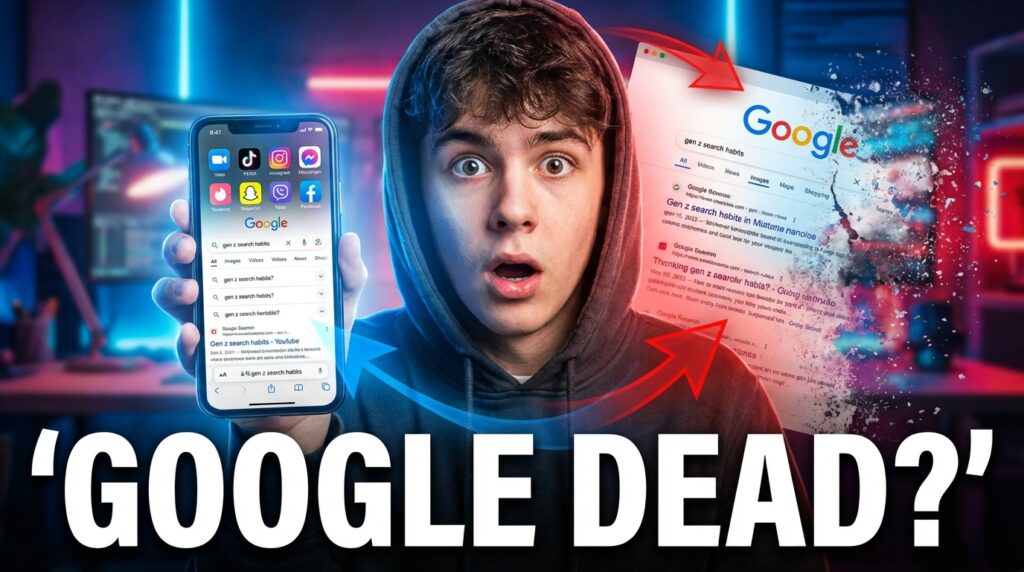

Let’s cut to the chase. How often do you actually type in “best Italian restaurant near me” in Google ( Social Search Trend ), expecting the top-rated site to be any good?
If you are like most people in 2026, probably never. Most likely, you are checking Instagram for the aesthetic or Tiktok for whether the pasta looks good on a real-life plate.
For the last two decades, the default reaction to something we didn’t know or were unsure about has been to ‘google it.’ But what we’re experiencing right now is a significant shift in the way we search the web – the largest since the arrival of the internet. The Social Search Trend is no small talk; it’s the new reality. In fact, according to our data from early 2026, nearly 45% of Gen Z and Alpha users both start and end their search process within social apps, bypassing search engines altogether.
Why? Because in a world chock-full of AI-generated prose and SEO spam, what we need most is something, just one thing: evidence that something is, well, real.
Well, that’s it for the in-depth look into how social media is becoming the new face of the world’s greatest search engine and the future of the internet.
- The Trust Deficit: Humans vs. “AI Slop”
- Visual Validation: Why Reading is “Out”
- The Rise of “Social SEO” in 2026
- Platform Breakdown: Who Owns What Search?
- The “Zero-Click” Consumer Economy
- Will Google Actually Die?
- FAQs
The Trust Deficit: Humans vs. “AI Slop”
The underlying driver of the need for Social Search is the erosion of trust associated with regular text search results.
Old-school search engines were chock full of what we now call “AI Slop”—boring content written by robots with no real value to offer. “Here are the top 10 vacuum cleaners,” written by an author who has never even swept a floor with its robotic brethren. By 2025.
Social Media fixed that with their “Face Factor.”
Verification: On Tik Tok or YouTube, you will be able to see the person. You will also be able to assess the tone of the person, the background, and even the honesty of the person
The Comments Section: by 2026, the comments have outpaced the content. If someone is dishonest, Community Notes or the first comment calls them out immediately.
We don’t want the “best” answer selected by a machine; we want the actual answer validated by a human.
Visual Validation: Why Reading is “Out”
Now, instead of an information-driven economy, we have a validation-driven economy.
If, say, you are searching for a video or blog tutorial on “how to fix a leaking sink,” you don’t really need a 2000-word blog post full of pop-up ads, do you? What you need is a 60-second video showing you exactly what to do with that wrench.
“The ‘Vibe Check’ Metric…is huge for travel and hospitality businesses. In 2026, a shiny 5-star Google Maps rating won’t mean much if the Instagram location tag indicates dry-looking food!” The power of social media searches has people “vibe checking,” or looking at the “reality” of an experience “before” people invest in it. People “want to see the unedited video of the actual experience…not the ‘curated’ photo,”
The Rise of “Social SEO” in 2026
The creators noticed this shift and moved along with it. Currently, “Social SEO” is the fastest-growing skill in digital marketing.
Social feeds aren’t endless timelines anymore, they are semantic search engines.
What people say out loud: Algorithms are now able to transcribe audio in real time. This means if a beauty influencer mentions in their video the terms, “best moisturizer for dry skin”, that clip gets indexed for those exact terms.
Alt text and captions: Creators are stuffing captions with long-tail keywords, such as “Budget solo travel tips for Japan 2026,” so they pop in relevant searches.
Local SEO: Instagram and TikTok geotags have become more powerful than Yelp.
Platform Breakdown: Who Owns What Search?
Not all social search behaves in the same ways. People tailor their searches according to their intent in 2026:
- TikTok: Ideal for quick answers, how-to guides, life hacks, recipes, and products review.
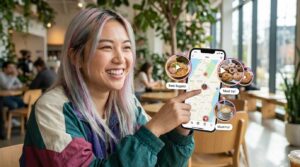
- Instagram, The Visual Explorer—perfect for travel, food, fashion, and discovering new locations.
- Reddit: the truth seeker—a person usually adds “Reddit” to “Google” to go around artificial intelligence filters.
- Pinterest: the aesthetic curator—ideal for home decor, wedding planning, and visual brainstorming!
- YouTube: The deep dive companion – when you want a 20 minute video rather than 60-second video.
The “Zero-Click” Consumer Economy
The older search engines force users to go away to find what they need, whereas social sites keep users engaged in place.
This change has spawned the Zero-Click Consumer. So, the search for the best running shoes on TikTok Shop or Instagram in 2026 will take the following course:
You see the review.
You probably have read the comments.
You buy the shoes. all without leaving the app. Such friction-free experience is eroding the effectiveness of the traditional methods of search engines optimization in e-commerce. Those trying to drive traffic to their sites are losing to sellers using the feed itself.
Will Google Actually Die?
Let’s not overdramatize things. Google is not dying; it is simply changing.
Envision Google as a new ‘Utility Engine’.
We use Google for things like stock quotes, weather forecasts, medical journals, research articles, and practical navigation (like finding the login pages of our banks).
Social is what we use for our lifestyle, opinions, culture, and shopping.
Google is about facts. Social is about feelings. And since we are naturally emotional beings, social search is winning the day when it comes to our attention.
FAQs
1. Is Social Search critical for local businesses?
Absolutely. If your café in 2026 doesn’t have a searchable Instagram location tag or user-generated TikTok content, it will become invisible to anyone under the age of 35. Google Maps won’t save local businesses in this scenario.
2. Can what I see on TikTok/Instagram be trusted?
It is important to be careful with what you read in the media. Even though what builds trust, as mentioned above, is Face Factor, misconceptions spread very quickly. However, it is easier to dispel false information through 2026 ‘community notes’ on most platforms than to filter through an SEO blog with very low credibility itself.
3. How do I fine-tune the content to best reach Social Search?
Stop using the generic #FYP. Know your keywords and incorporate them into your screen text and your voiceover. Optimize your caption to be like a title on a blog. Ask the specific questions your audience wants answered.
External Authoritative Sources
-
Search Engine Land – For technical breakdowns of search algorithm updates.
-
Pew Research Center – For data on Gen Z digital habits.
-
Social Media Today – For news on platform-specific search features.