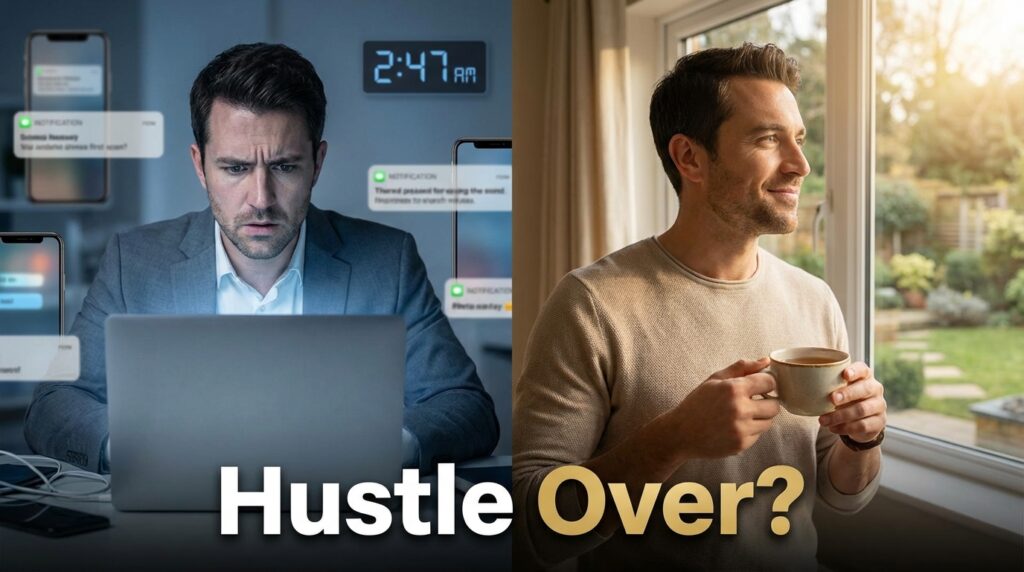

If you’re reading this, you’re probably bone-tired, not the kind that can be cured with a nap, but the kind that comes from years of living, squeezing every last second out ( Slow Living Culture ) of existence.
Welcome to 2026. The year the Grindset finally gave out.
For a long time, we’ve been fed a lie: wake up at 4 a.m., indulge in numerous ice baths, focus on pursuing ‘passive income streams,’ and you’ll somehow attain some state of bliss? What happened? We’ve got a burnout problem on our hands instead. The mental health of the modern working class has finally snapped, and a new mentality has been born.
It’s Slow Living Culture, though the name could be misleading. It is not about being irresponsible and leaving your job to make baskets in a tent (if that is what floats your boat). Intention is a big part of it. Intensity is less of a focus than durability.
What gets decorated in 2026? Well, it ain’t no gold watch, no “30 under 30” shout-out. What gets decorated? It’s having dinner on Tuesday night with no date on the calendar. It’s being able to sit in a chair for 20 minutes without reaching for your phone.
Here’s how I would argue that the hustle is over and that Slow Living is the new survival mechanism for the age of artificial intelligence.
- The Great Exhale: Why 2026 is the Year of “Enough”
- Slow Productivity: The “Final 5%” Philosophy
- Analog Anchors: Rebellion Against the AI Flood
- JOMO & The Rise of the “Solo Society”
- The “Soft Home” Aesthetic: Warmth Over Sterile Minimalism
- How to Adopt Slow Living (Without Going Broke)
- FAQs
- Final Verdict
The Great Exhale: Why 2026 is the Year of “Enough”
The mid-2020s became a feverish sprint to outpace AI technology. A belief in needing to outproduce the machines drove us. We failed to outproduce them.
Now the rhythm is reversing: a large cultural shift has begun to move away from perpetual optimization and return to a focus on humanity.
The Economic Shift: The promise of hustle culture, that hard work translates to wealth, has begun to fracture. In a volatile world, the lesson that trading health for a job that could be replaced by a computer program isn’t a fair bargain is sinking in.
The “Minorstones”: We’ve stopped only applauding the big jumps upward on the ladder. In 2026, we are going to mark the “Minorstones,” the small victories in a day. G
etting a book finished. Cooking a meal from scratch. Fixing a leaky faucet. These are the new measures of a life well lived.
Slow Productivity: The “Final 5%” Philosophy
Hustle culture pushed us to go faster, juggle more. In contrast, slow living has to do with doing fewer things but with more care.
There’s a growing concept out there in leadership circles known as “The Final 5%.” In the normal busy lives of most individuals, they usually push through 95% of a project just to check it off and dive into the next task. Slow Productivity argues that true value-and real satisfaction-shows up in that last 5%. It’s the extra refinement, the finish, the careful attention to detail that AI can’t imitate.
The New Rules of Work:
Deep Work Blocks: No Slack, no email, no meetings for four hours. Just one task at a time.
Async by Default: We’ve stopped counting on instant responses. “I’ll get back to you tomorrow” is its own complete sentence.
The 4-Day Reality: Whether formal or informal, the Soft Friday has become the norm.
Analog Anchors: Rebellion Against the AI Flood
The digital scene in 2026 seems chaotic, synthetic, and impossible to avoid. In order to preserve our sanity, we are creating Analog Anchors.
We yearn for friction – for things that are hard.
Dumb Phones: The Light Phone phenomenon has exploded in recent times. People are ditching their AR glasses and smart phones over the weekends.
Physical Media
vinyl records are booming like never before, and so are physical books, film cameras, and CDs. We want to hold the art we consume physically.
Handcrafts: Pottery places and woodworking shops are full of activity. There is something primal within each person to make something that is real, something that is marked by the imperfect results of the wind—a creation that tells people it was made by a human being.

JOMO & The Rise of the “Solo Society”
Well, FOMO, also known as the fear of missing out, is so last season. JOMO, or the Joy Of Missing Out, has
Enter the Solo Society, where solo activities like dining, backpacking, and catching a movie at night are no longer lonely but luxurious, and smartively conscious.
There is no shortage of solo dining, and restaurants have been responding by reconfiguring their dining spaces closer to what one-person meals require.
And in travel, the fastest-growing segment is “Silent Travel,” which are trips to quiet retreats where all technology and even noise are banned.
The “Soft Home” Aesthetic: Warmth Over Sterile Minimalism
The age of ‘Sad Beige’ has passed. The hyper-clean, gallery-inspired, ultra-minimalism of the early part of the 2020s, which felt so uninviting after the world outside underwent such upheaval.
In 2026, homes are embracing softness.
Organic Minimalism: curved lines instead of hard angles. Think curved sofa, archways, and non-traditional mirror shapes.
The Materials: people demand honest materials. Raw wood with visible grain, unpainted stone, terracotta, and linen.
Slow Decorating: The age of Fast Furniture has past; for many of us, no problem with leaving a wall blank for six months to find the perfect second-hand furniture item.
How to Adopt Slow Living (Without Going Broke)
You don’t have to have a trust fund to slow down. Here is a guide to help people in the workforce in 2026:
The Low Stimulation Morning: Forgo screens for the first hour of the day. Drink coffee, look out the window, and stretch. It sets your dopamine level.
Single-Tasking: When you are eating, just eat. When you are walking, just walk. Stop podcasts at normal speed and refrain from checking emails at the same time.
Audit Your Subscriptions: Get rid of the noise-filled services. Keep those with real art or real value.
“Say ‘No’ More:” Guard your time as you would your savings. If it’s not a Hell Yes, it’s a No.
FAQs
1. Is Slow Living for the one percent only?
Not necessarily. The aesthetic-so think high-end linen and artisanal organic produce-can be costly, but the philosophy itself is free. Saying no to additional commitments, silencing notifications, and cooking simple meals at home actually saves money. It’s about choosing time over stuff.
2. Will I fall behind in my career if I stop hustling?
The numbers in 2026 indicate not. Hustlers burn out and make mistakes, while slow movers tend to produce higher-quality work, make smarter choices, and just plain last longer. Sustainability has become the real your-advantage.
3. How do I get started with digital minimalism?
It suggests starting with “Phone-Free Zones.” That means putting the phones away when you’re in the bedroom, away from the dining table. Then try a “Dumb Phone Weekend”—unplugged from the internet entirely from Friday night to Monday morning.
Final Verdict
While 2026’s Slow Living trend is not about escaping reality, it is about selecting a more intelligent way of living in that reality.
We’ve learned that life is not a dash to get to that finish line; it’s a set of moments, and if you rush through those moments, then you’ve completely missed it. So, close that computer, grab a drink, and sit back and appreciate that quiet for a moment. Those emails will get sent tomorrow.
Ready to ditch the hustle? Tell me in the comments.
External Authoritative Sources
-
The Slow Movement – The philosophy behind the global trend.
-
Cal Newport’s Blog – Deep Work and Digital Minimalism resources.
-
Mega Magazine Lifestyle Forecast – Cultural analysis of the 2026 trends.